
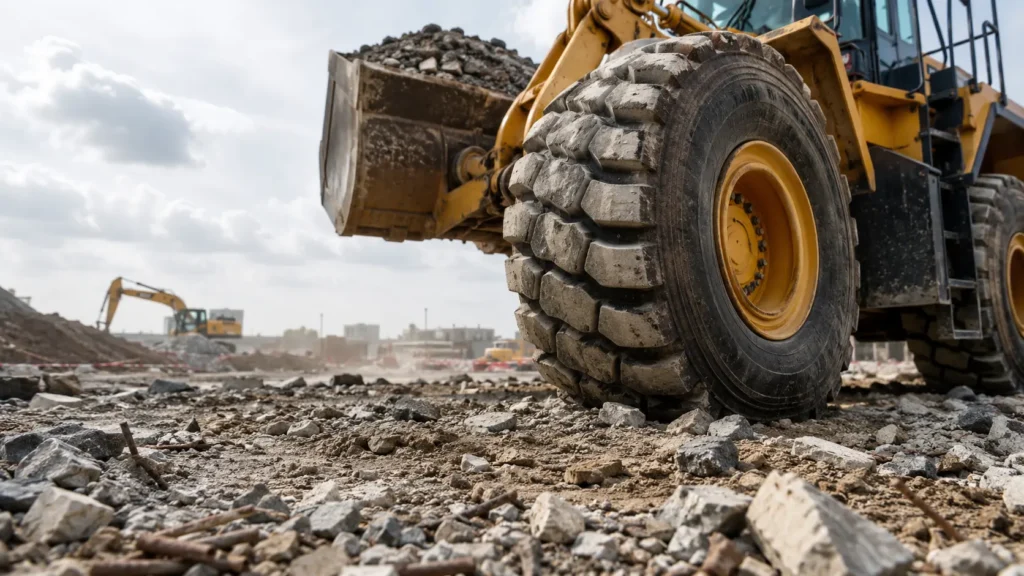
Industrial tires are designed to withstand extreme working conditions. However, even the most robust models can suffer a puncture or damage when operating on demanding worksites.
A puncture doesn’t just represent the cost of a tire. It can lead to a machine being immobilized, delay the progress of work and increase operating costs.
What are the main causes of punctures on a construction site? And above all, how can they be prevented? Discover best practices to protect your industrial tires and ensure the continuity of your operations.
Unlike road tires, industrial tires operate daily on rough, uneven terrain and are often cluttered with materials that can damage the rubber.
Loaders, backhoe loaders, telescopic handlers or forklifts are required to cross rubble, stones, curbs and sometimes metal waste.
Even a high-quality tire can be weakened if the conditions of use are not suitable.
One of the most frequent causes of punctures is the presence of sharp objects on the ground.
Among the most dangerous elements:
These objects can puncture the tread or sidewall of the tire, especially when the machine is carrying heavy loads.
Tip: Keeping traffic areas clean and regularly removing debris greatly reduces risks.
On quarries or certain construction sites, tires are constantly rolling over angular rocks.
These surfaces cause:
When the stones are particularly aggressive, it is recommended to use tires suitable for harsh environments.
Pressure plays a vital role in tire resistance.
An underinflated tire deforms more and exposes its sidewalls more to cuts.
Conversely, an overinflated tire absorbs shocks less well and becomes more vulnerable to impacts.
Regular tire pressure checks help maintain performance and improve tire life.
Each industrial tire has a maximum load capacity.
When this limit is repeatedly exceeded, the tire undergoes significant stresses that accelerate its wear and increase the risk of failure.
Following the manufacturer’s recommendations helps to preserve the safety of the machine and the reliability of the tires.
On logistics platforms or urban construction sites, tires are regularly subjected to impacts against:
These impacts can cause cuts or deformations, sometimes invisible to the naked eye but likely to weaken the structure of the tire.
Not all industrial tires are designed for the same working conditions.
A tire intended for a logistics platform will not react in the same way on a quarry or a demolition site.
Choosing a tread pattern and design suited to your environment helps limit the risk of punctures and improve machine performance.
A few simple steps can reduce the risks:
Preventive maintenance helps to avoid many unforeseen breakdowns.
PneuPro offers a wide selection of industrial tires suitable for backhoe loaders, loaders, forklifts, telescopic handlers and other professional equipment.
Thanks to our search by dimension, you can quickly find models compatible with your machine and adapted to the constraints of your work environment.
Metal objects, construction debris, and sharp stones are among the most frequent causes of punctures or damage to industrial tires.
Yes. Too low or too high a pressure weakens the tire and increases the risk of damage when driving on rough terrain.
No. Some models are designed for logistics platforms, while others are specifically developed for quarries, construction sites, or particularly abrasive environments.
Regular inspections, pressure checks, cleaning of traffic areas and choosing tires suitable for working conditions help to limit risks.
PneuPro offers a complete range of industrial tires for the main construction equipment, available in many sizes and from brands recognized for their reliability.